What happened, in short
In March 2024 my electricity retailer, Nectr, sold me a solar and battery system as part of a power plan. I am paying it off through my electricity bill. For six months that worked. Then the battery stopped doing the one thing it was bought to do, and since then I have been passed from company to company. Here is the whole story in six points. The detail and the evidence for each is further down the page.
1. I bought a $29,882 solar battery through my power company — and I'm still paying for it
- Sold by Nectr as its "Nectr Bee System Bundle", installed by Online Air & Solar, made by Enphase.
- $25,854 is financed by Nectr's finance company and repaid at $430.90 a month on my electricity bill. $13,357.90 is still owing.
2. Since about April 2026, the battery won't charge from the grid when it's scheduled to
- It's set to charge overnight on cheap power so the house runs on it during the expensive peak. Instead it sits empty, and I buy peak power from the grid.
- Documented on 18 May, 20 May, 18 September and 30 September 2026. The proof is below.
3. The proof: the settings say "charge", the battery says "no"
- 18 September 2026, two screenshots fifteen seconds apart: grid charging on, scheduled from 9:05 pm, target 100%. Eighty-two minutes in, the battery is at 10% and has charged 0.0 kWh.
- Enphase's own technician had already confirmed in writing (28 May 2026) that during that window "it will pull from the grid". Months later another Enphase representative told me it shouldn't charge from the grid at all.
4. Six months of "it's fixed now" — and it isn't
- Remote firmware updates, again and again. One installer visit, on 2 October, was spent on the phone to Enphase, and the promised fix failed.
- No Enphase technician has ever come to look at it.
5. It has cost me $1,269 in extra power — and they offered $150
- Grid use is up 91% on the same months last year. The figures are below.
6. Each company blames another — and all three ignored my formal demand
- Nectr says it's Enphase's problem. Enphase finds "no active fault" remotely. The installer defers to Enphase.
- A letter of demand to all three on 16 October asked for a reply by 30 October. None of them replied.
- I can't simply walk away: if I leave Nectr, the finance balance can be called in.
Update — 3 November 2026
The formal demand has been ignored. A letter of demand with five supporting attachments went to all three companies together on 16 October 2026, asking for a written response by 30 October. None of them responded. Enphase sent an automated ticket and a satisfaction survey. Online Air & Solar sent a marketing email. Nectr sent the next bill.
- 2 November 2026: formal billing dispute and rejection of the system under the Australian Consumer Law (ss 54, 259, 260, 263), served on all three. Nectr's finance company is named as a linked credit provider (s 278), jointly liable with the supplier. The monthly $430.90 instalment is now disputed. Electricity usage continues to be paid. A response is required by 16 November 2026, after which the matter goes to VCAT.
- Consumer Affairs Victoria: complaint lodged 19 October 2026 (C2026/10/007957).
- 3 November 2026: the Essential Services Commission confirmed receipt of a complaint about Nectr. The local state MP (Bundoora) and Banyule City Council are both engaged. SolarQuotes, which lists the installer as a client, is investigating.
- Also lodged 2 November 2026: ACCC report (accc-report:0185392) · New Energy Tech Consumer Code complaint against Nectr (Case 00003578) · Australian Financial Complaints Authority, against Nectr's finance company.
- Energy and Water Ombudsman (Victoria): on 20 October 2026 the complaint was declined as being about a "faulty solar product". A request for reconsideration was sent on 2 November: Nectr is an EWOV member, sold the system as part of its electricity plan, and bills the repayments on the electricity bill.
What's on this page
- What happened, in short
- The contradiction
- Two screenshots, fifteen seconds apart
- How it was sold to work
- Their marketing vs what I was told
- Every claim, tested
- Why "all microinverters reporting" means nothing
- The full timeline
- The evidence, screenshot by screenshot
- What it has cost
- What I'm asking for
- The schedule of claim
1 — The contradiction
On 28 May 2026, a Customer Service Technician at Enphase Energy wrote to my installer about this exact system:
“Currently, it is charging from the grid since it is between 9:15 and 2:45 p.m settings. During the charge from the grid time, it will prioritize charging the batteries and won't discharge, and it will pull from the grid as it would be charging the batteries anyway.” Enphase Energy, Customer Service Technician — in writing, 28 May 2026
In October 2026, on a three-way call between me, my installer's technician and Enphase, an Enphase representative told me the battery should not charge from the grid at all.
Enphase has stated both positions about one system — in writing, and by telephone, five months apart. One of them is false.
On that same call, the representative confirmed he had not looked at the email history, and had not looked at any of the screenshots documenting the fault.
2 — Two screenshots, fifteen seconds apart
These two images were captured at 00:27 on 18 September 2026, both carrying embedded capture metadata. Together they remove every explanation I have been given.
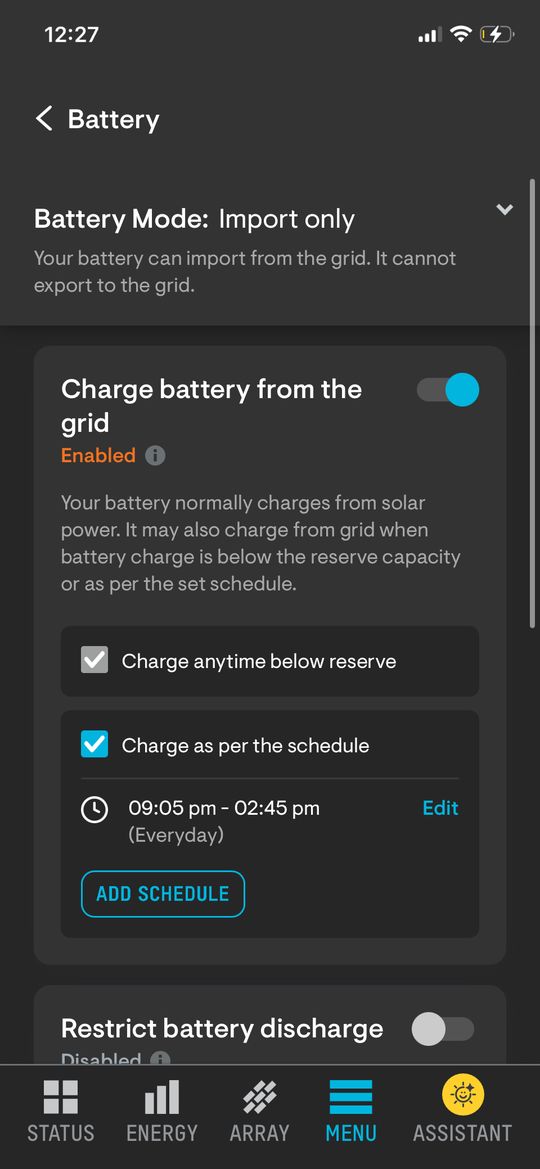 SETTINGS CORRECT
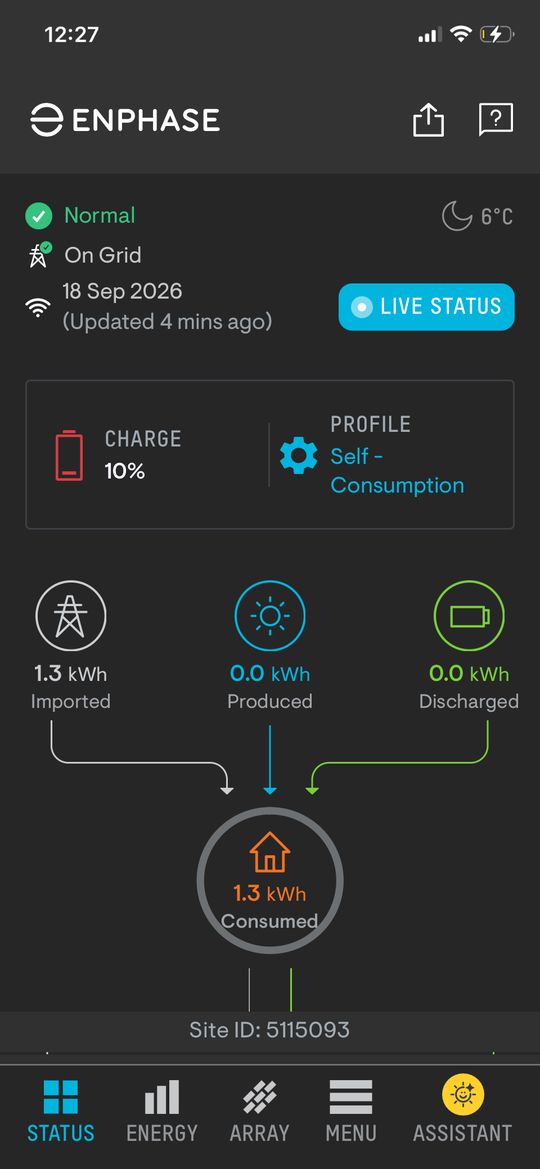 AND IT DID NOTHING
The first: the battery settings page
| Setting | As shown |
|---|---|
| Battery Mode | Import only — “your battery can import from the grid” |
| Charge battery from the grid | ENABLED |
| Charge anytime below reserve | CHECKED |
| Charge as per the schedule | CHECKED |
| Schedule | 09:05 pm – 02:45 pm (Everyday) |
| Restrict battery discharge | Disabled — discharge permitted |
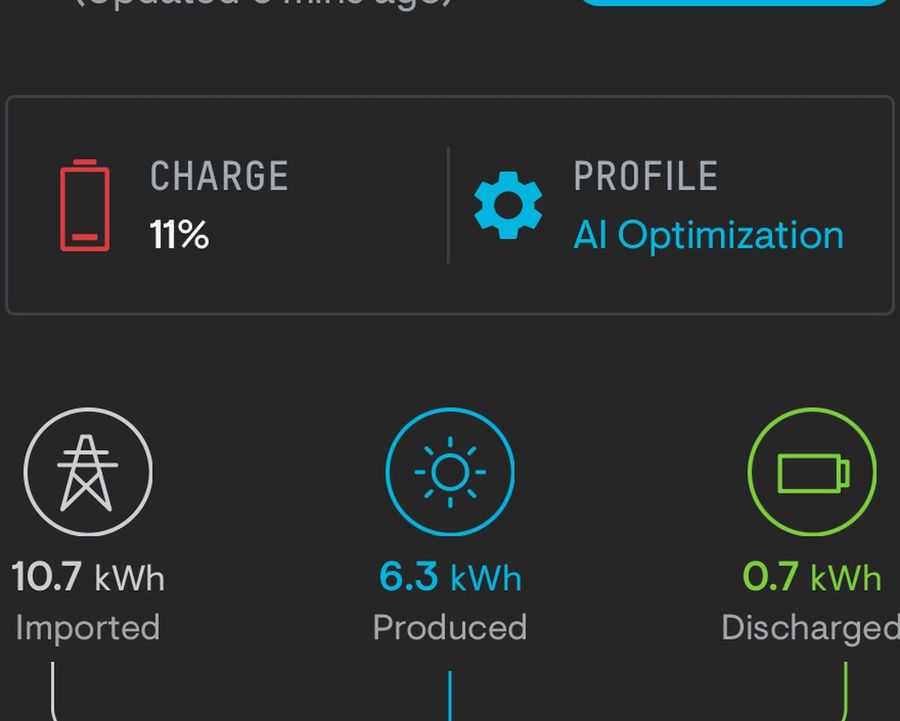
The second, fifteen seconds later: the system in that window
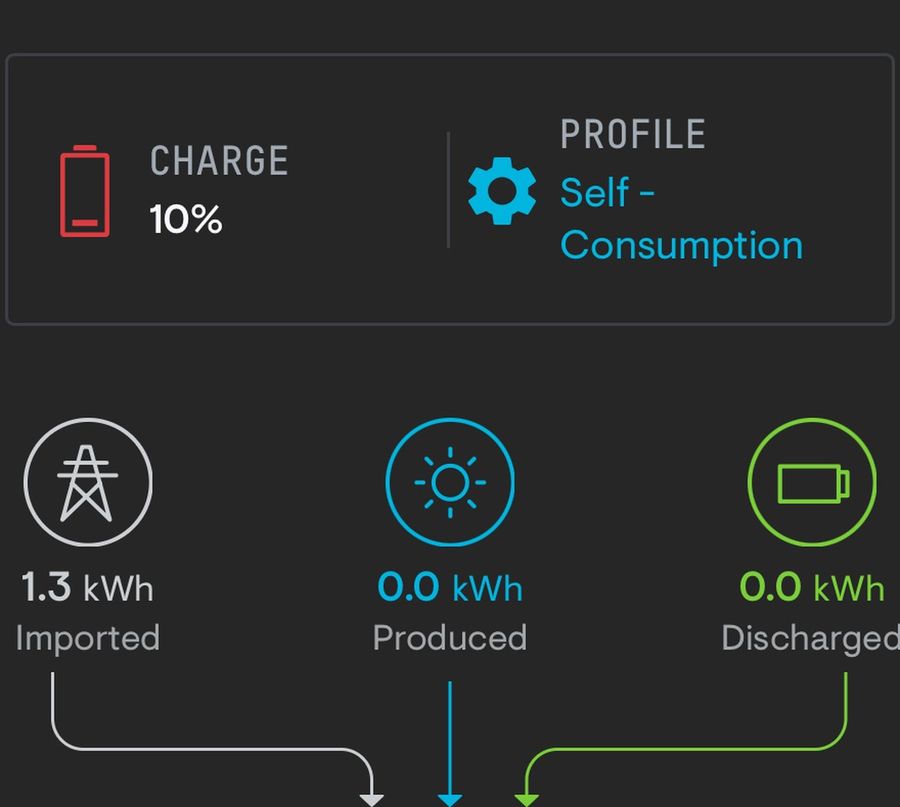
Read them together. The system was three hours and twenty-two minutes into its own scheduled grid-charging window. Grid charging was enabled. The below-reserve override was enabled. The battery was at 10%. The house was importing from the grid. There was no solar — it was after midnight at six degrees.
The battery took none of it.
Not a settings problem. Not a profile problem. Not a tariff misunderstanding. The schedule was right, the feature was on, the battery was nearly empty, grid power was flowing into the house — and it did not charge.
And note the setting that makes the schedule irrelevant: “Charge anytime below reserve” was checked. That instruction does not depend on any schedule or any time of day. The reserve on this system was 15% (per Enphase, via my installer, 25 May). At 10% the battery was below it, and should have been drawing from the grid regardless.
And then my schedule changed, and I didn't change it
| Date | Grid-charge schedule shown in the app |
|---|---|
| 18 September 2026 | 09:05 pm – 02:45 pm |
| 16 October 2026 | 09:00 am – 02:45 pm |
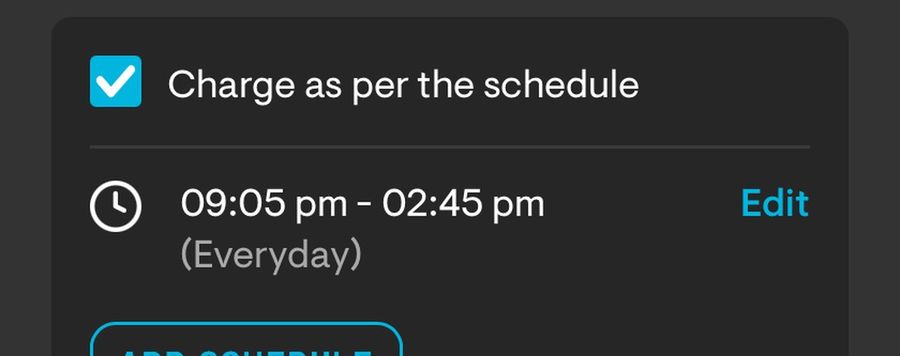
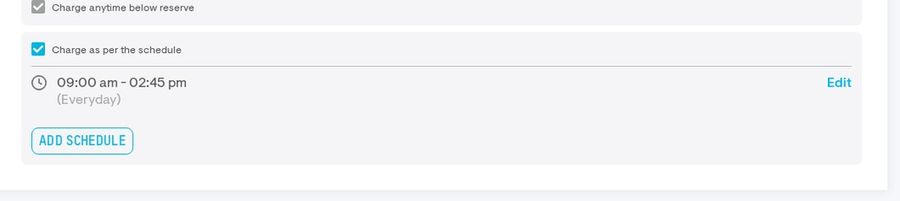
The start time moved from nine at night to nine in the morning. I did not make that change, I was not told of it, and nobody has explained it. Its effect is to exclude the entire overnight period — the only hours in which grid charging can do anything, because there is no sun.
This is the thing I have been trying to describe for five months. The system does not hold a working state. After a reset or a remote session it may behave for a few days, then it drifts back — sometimes intermittently, sometimes completely. Settings do not stay where I put them.
A system that needs constant supervision, repeated resets and periodic re-entry of its own settings is not fit for the purpose it was sold for.
Every device reports perfectly healthy
| Group | Count | Status |
|---|---|---|
| IQ Gateway | 1 | Normal |
| Roof microinverters (IQ8AC) | 20 / 20 | All Normal |
| IQ Battery 5P | 2 of 2 active | Normal |
| Devices not reporting Normal | 0 | — |
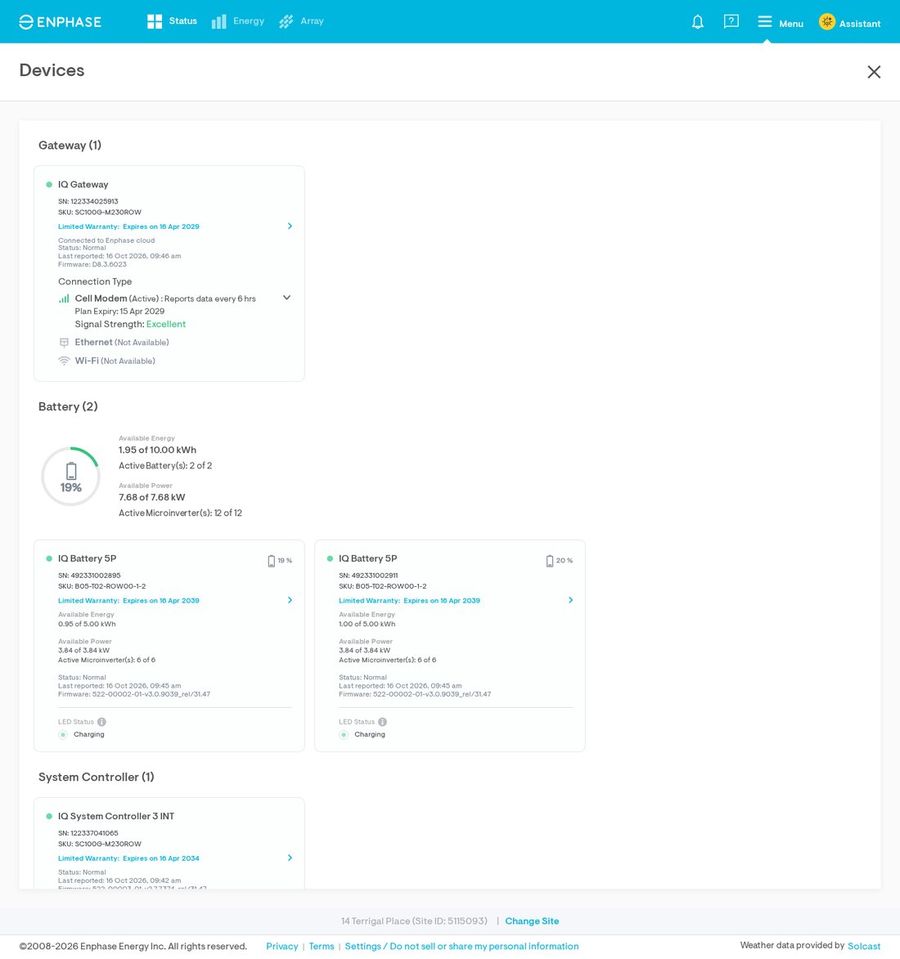
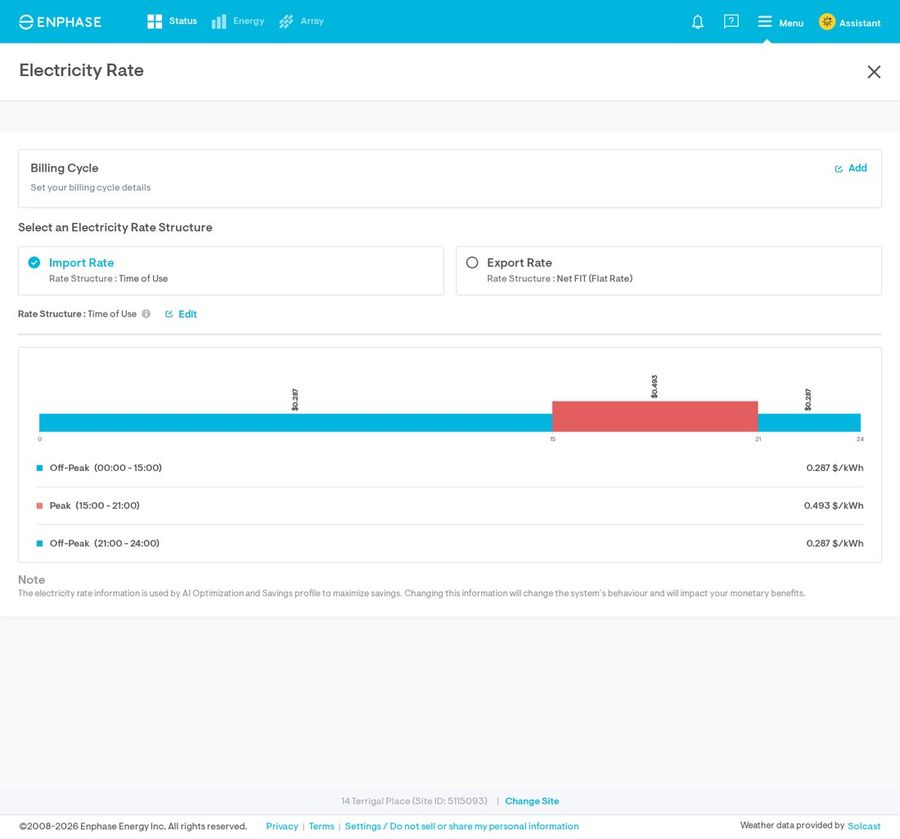
Nothing is offline, missing or faulted. The hardware reports itself healthy and does not do what it is told. That is exactly why five months of remote telemetry checks keep returning “no fault found” — and exactly why somebody needed to physically look at it.
3 — How it was sold to work, and what happens instead
My tariff, from the same portal: off-peak 00:00–15:00 and 21:00–24:00 at $0.287/kWh; peak 15:00–21:00 at $0.493/kWh.
Figure 1 — The system as sold, and as configured in the Enphase app. It worked this way for roughly the first six months.
4 — Their marketing, beside what I was told
These are published descriptions of the product I bought, set against what I was told when it stopped working.
| What the product promises | What I was told |
|---|---|
| Storm Guard “monitors data from the Australian Bureau of Meteorology and will automatically charge the battery to help homeowners prepare for possible grid outages due to severe weather events.”Enphase Energy, Australian launch announcement, IQ Battery 5P | “The battery should not charge from the grid.”Enphase representative, three-way call, October 2026 |
| “Your EV and home batteries will charge from solar as a first choice, and the grid is used as a second choice until the storm alert is on for your system.”Enphase, Automatically charge ahead of severe weather — enphase.com/charging-101 | “There's no problem — it's charging from solar.”Enphase representative, three-way call, October 2026 |
| “This condition is designed to self-correct once the battery receives sufficient charge either from available solar production or from the grid (if grid charging is enabled).”Online Air & Solar, relaying Enphase — 25 May 2026 | “It's a settings issue. Let's go through the app together.”Enphase first-level support, October 2026, with grid charging already enabled |
| The app's own control panel: “Charge battery from the grid” — Enabled · “Charge up to 100%” · “Charge anytime below reserve”Enphase Enlighten portal, this system, captured 16 October 2026 | “Both batteries operational and charging with no errors.”Enphase Technical Support APAC, 16 June 2026 |
Grid charging is not a feature I imagined. It is in the product announcement, in the manufacturer's own support documentation, in my installer's written explanation of how the fault should resolve itself, and on the settings page of my own system — switched on, with a 100% target.
5 — Every claim, tested against the record
| What I was told | Verdict | What the evidence shows |
|---|---|---|
| “The battery should not charge from the grid.”Enphase, Oct 2026 | ✗FALSE | Contradicted by Enphase's own technician in writing (28 May 2026), by the system's settings page, and by Enphase's published Storm Guard documentation. |
| “There's no problem — it's charging from solar.”Enphase, Oct 2026 | ✗MISLEADING | 18 Sep, 00:27, 6°C, after midnight: solar production 0.0 kWh, battery 10%, grid importing, charge window open — 0.0 kWh charged. There was no sun, and it did not charge. |
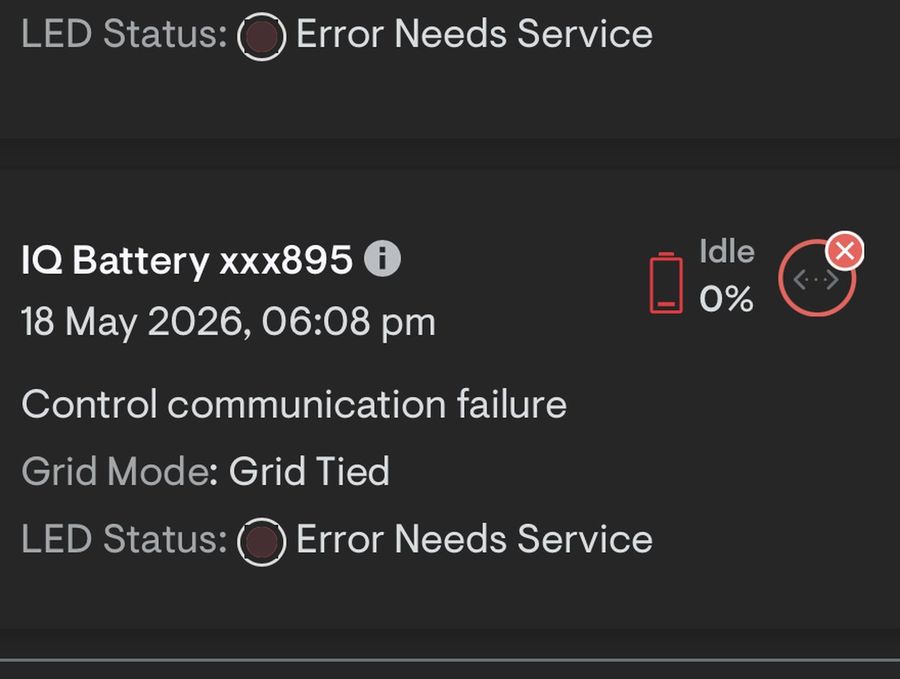
| “Both batteries operational and charging with no errors.”Enphase, 16 Jun 2026 | ✗FALSE | 18 May — both units Idle at 9%, both “Error Needs Service”; SN …895 logged “Control communication FAILURE” at 0%. |
| “No active fault detected.”Enphase via installer, 25 May 2026 | ✗WRONG ON ITS OWN DATE | 20 May at 13:21:07 — SN …895: Idle, 24%, “Error Needs Service” in red. This finding was used to refuse a site visit. |
| “All microinverters reporting and producing.”Enphase, 16 Jun 2026 | ✓TRUE — IRRELEVANT | Confirmed: 20/20, all Normal. But production reporting and battery control are different communication paths. See below. |
| “System may have shading.”Enphase, 16 Jun 2026 | ✗UNTESTED | Array unchanged since April 2024. No shade study, no per-panel analysis, no site visit. Shading has no relationship to grid charging. |
| “A firmware update will resolve this.”Enphase — three times | ✗FAILED 3 OF 3 | The third was given to my installer's technician on site, with the statement that there is a firmware fault with the battery, to be fixed over the weekend. Reported unfixed 6 Oct 2026. |
| “A calibration issue with the batteries, causing Enlighten to say 90% when they were 100%.”Enphase technician, 28 May 2026 | ⚠ADMITTED DEFECT | Enphase admitted in writing the batteries were mis-reporting their own state of charge — on the same platform later relied on for every “no fault detected” finding. Never remediated. |
| “It's a settings issue — let's go through the app together.”Enphase first-level support, Oct 2026 | ✗REFUTED | 18 Sep: the settings were correct. Grid charging enabled, schedule 09:05 pm, below-reserve checked, target 100%. Fifteen seconds later: 10% charge, 1.3 kWh imported, 0.0 charged, zero solar. The settings were right and it still did nothing. |
| — no explanation has ever been offered | ⚠UNEXPLAINED | My grid-charge schedule changed from 09:05 pm to 09:00 am between 18 Sep and 16 Oct. I did not change it. It happened during a period of Enphase remote sessions and firmware deployments. |
6 — Why “all microinverters reporting” answers nothing
This is the technical heart of it, and it is why a system can look perfect remotely and be unusable in the house.
Figure 3 — Production data travels one path; battery control travels another. All twenty microinverters can report perfectly while the battery is uncontrollable.
The correlation nobody drew
| 18 May — control communication | 20 May — state of charge | |
|---|---|---|
| SN …911 | ✓ “pairing complete” | 100% |
| SN …895 | ✗ “FAILURE” | 24% |
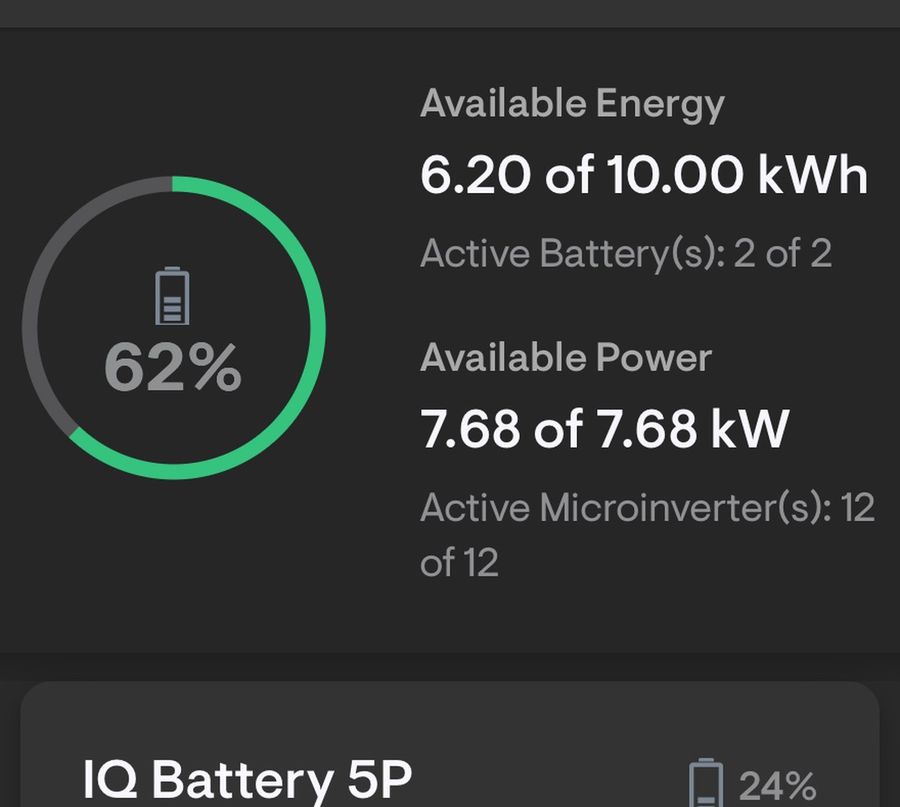
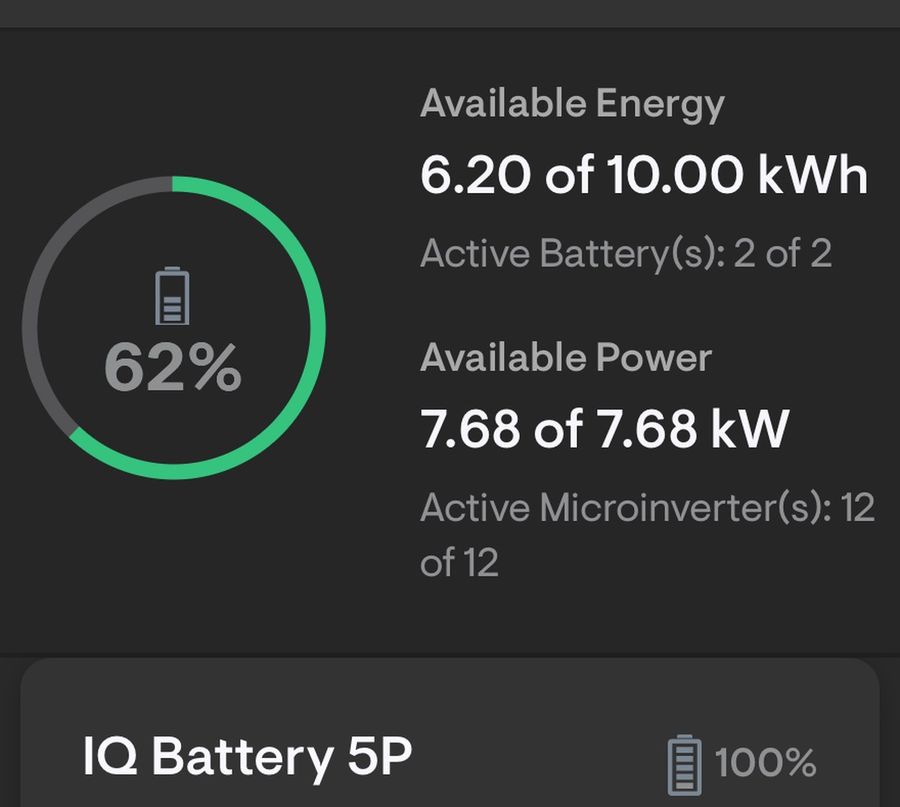
The unit that failed to pair is the unit that would not charge. Both facts sat in Enphase's own telemetry, two days apart, against two serial numbers, seven minutes apart on the day. No one connected them.
7 — The full timeline
- 20 March 2024System purchased
8.8 kW — 20 × DAS 440W panels, 20 × Enphase IQ8AC microinverters, 2 × Enphase IQ Battery 5P. $29,882.00, financed $25,854.00.
- April – September 2024It works
Self-consumption, Full Backup, Storm Guard and scheduled off-peak grid charging all functioning. October 2024 bill: 663.70 kWh for $188.70.
- ~April 2026Scheduled grid charging stops
Full Backup begins reporting a battery service error.
- 15 May 2026First report
“Despite having our system set to charge every day during off peak times our battery has stopped charging and discharging this month.”
- 18 May 2026The app names the fault
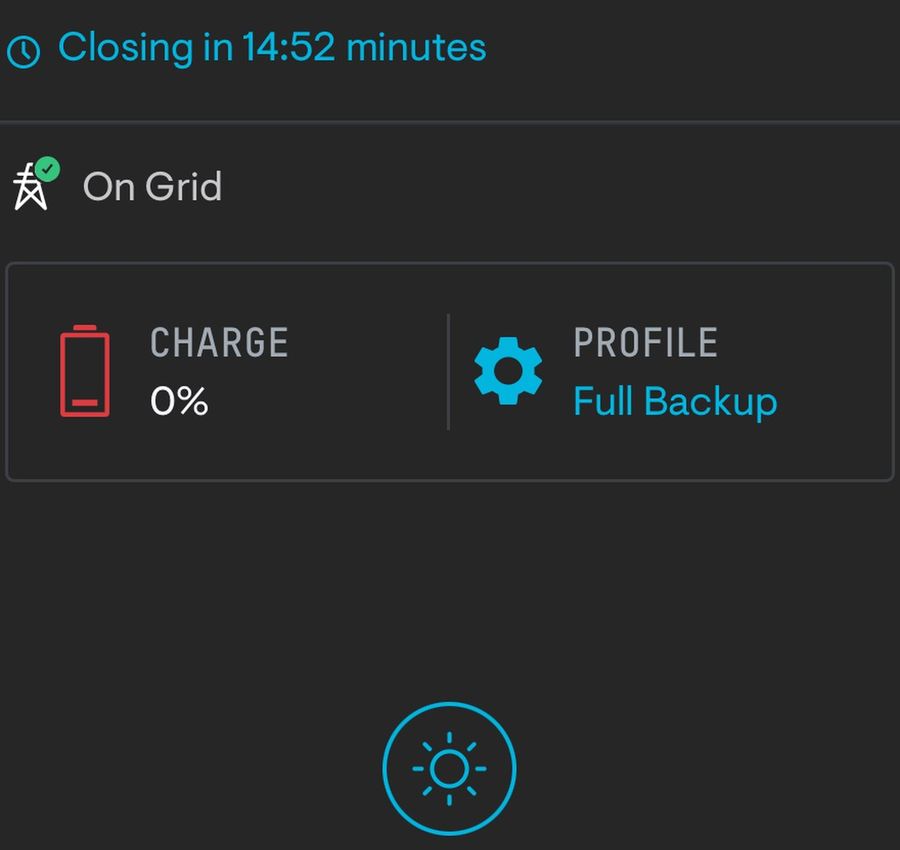
13:15 — both batteries Idle at 9%, both “Error Needs Service”. 18:12 — Full Backup, battery 0%, grid importing 4.0 kW, battery Idle. 18:18 — SN …895: “Control communication FAILURE”.
- 20 May 202624% and 100%, seven minutes apart
13:21:07 — SN …895 at 24%, “Error Needs Service” in red. 13:26 — SN …911 at 100%.
- 25 May 2026“No active fault detected”
Enphase, via the installer: the batteries “recharged on the 20th”, therefore “no active battery fault requiring physical service attendance.” A site visit is refused on a finding that was wrong on the day it was made.
- 28 May 2026Ticket #19981529 raised — and grid charging confirmed
The installer calls Enphase twice, selects a callback both times, receives neither. Enphase's technician writes: “it is charging from the grid… it will pull from the grid”, and admits a battery calibration fault mis-reporting 90% as 100%.
- 4 June 2026$150 offered
Against a measured excess of $1,269.10 — under 12%. Reported as still not applied three weeks later.
- 9 June 2026“Boots on the ground, not middle-manning”
I ask, in writing, for someone to come and look at it in person. Nobody does.
- 11 June 2026“I'd much rather just get the thing fixed”
Repair requested in writing, in preference to any legal route.
- 16 June 2026Five claims from Enphase APAC
Batteries operational with no errors · all microinverters reporting · possible shading · AI optimisation “experimental and not recommended” · revert to self-consumption. I reverted. The faults persisted.
- 18–22 September 2026The circle closes
Formal VCAT notice given. Nectr acknowledges “around six months” of issues, acknowledges the installer refuses onsite checks, and refers me back to Enphase.
- 1 October 2026“I won't sit on the phone for hours troubleshooting again”
After another call, I decline further remote troubleshooting on a work day and ask for someone to attend: “Any other troubleshooting will need to be done onsite by yourselves where I can clearly demonstrate that the battery does not charge from the grid during off peak as designed and configured in the Enphase app.” The installer confirms it will not send a technician until Enphase provides its assessment first.
- Friday 2 October 2026A technician finally attends — and Enphase identifies a fault
An Online Air & Solar technician attends and spends about 90 minutes troubleshooting with Enphase by telephone. Enphase tells him there is an issue, that it looks like firmware to them, and that an update being deployed over the weekend should fix it.
I say at the time, in front of him, that I have been given that exact answer before, and that I suspect a deeper hardware fault. He says the diagnosis is inconclusive, but that if the firmware fails they will continue troubleshooting at the hardware level.
- 6 October 2026It was not fixed
“The proposed update Enphase attested would fix our system over the weekend has not resulted in it charging from 9pm to 3pm.” Third firmware promise, third failure. A hardware solution is requested. None has ever been offered.
- October 2026Back to first-level support — and the fault is denied
The hardware troubleshooting never happens. Instead the next step is another Enphase first-level technician, wanting me to open the app and change settings with him — who has not looked at any of the three months of historical settings and screenshots I had already supplied.
He tells me there is no problem, it's charging from solar, and the battery should not charge from the grid at all. I am then asked to reset the system to factory defaults — which would erase the configuration that proves the fault. I decline.
- 16 October 2026Where it stands
I log into the portal and find my grid-charge schedule reading 09:00 am, where it read 09:05 pm in September. No Enphase technician has ever attended. No hardware has been replaced. The matter has never left first-level support. No finding was issued after reading the evidence file.
- 16 October 2026Letter of demand served on all three
Sent to Online Air & Solar, Enphase and Nectr together, with five attachments (timeline, diagnostic report, configuration audit, claims against evidence, screenshot catalogue). Written response required by 30 October 2026.
- 19 October 2026Consumer Affairs Victoria
Complaint lodged — reference C2026/10/007957.
- 20 October 2026The ombudsman declines — on the wrong question
EWOV declines the complaint as being about a "faulty solar product". But the respondent is Nectr — an EWOV member — which sold the system as part of its electricity plan and bills the repayments, $430.90 a month, on the electricity bill. Reconsideration requested 2 November.
- 30 October 2026The deadline passes. Silence.
No written response from any of the three companies. Enphase: an automated ticket and a satisfaction survey. Online Air & Solar: a marketing email. Nectr: the next bill.
- 2 November 2026Billing dispute and rejection
The system is formally rejected under s 259(3) of the Australian Consumer Law as a major failure. The instalment is disputed. Nectr's finance company is held to account as a linked credit provider (s 278). Response required by 16 November 2026 — then VCAT.
8 — The evidence, screenshot by screenshot
Forty-one files. Thirty-one carry the capture date embedded by the phone at the moment the picture was taken — not the date they were sent. The dates verify each other: image5.png has an embedded time of 20 May 2026 13:21:07, and the Enphase app prints “20 May 2026, 01:19 pm” inside the same image.
Beside each one is a single line: what it does to the complaint.
18 May 2026 — the fault appears, and the app names it
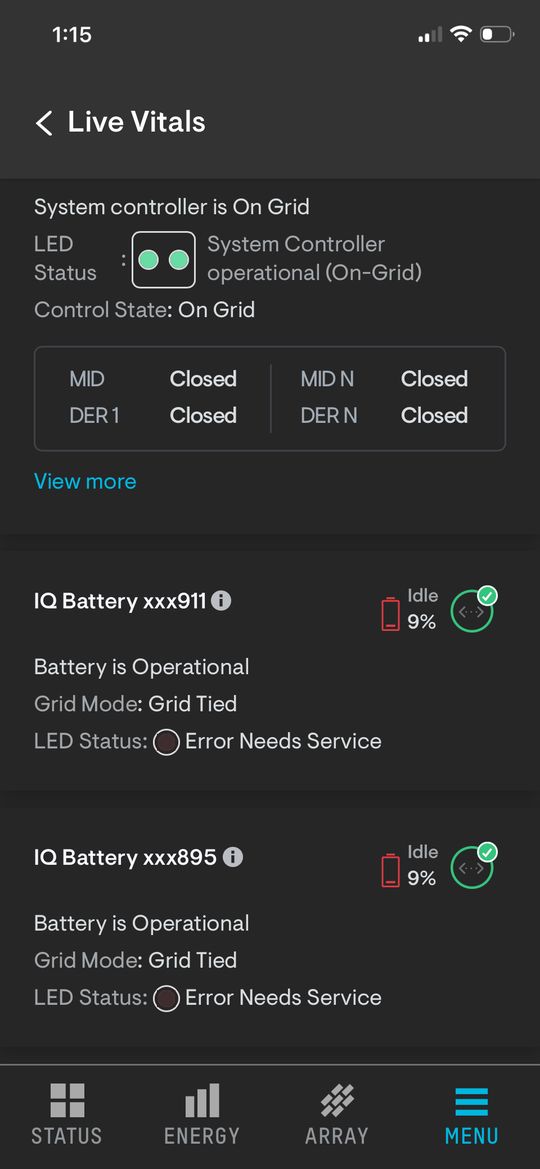 CONTRADICTS ITSELF
Both batteries at once: Idle, 9% charge, “Battery is Operational” and “LED Status: Error Needs Service”.
Why it matters: this is how the wrong answer gets made. A remote operator reads the top line and reports “operational, no errors” — ignoring the fault line directly beneath it.
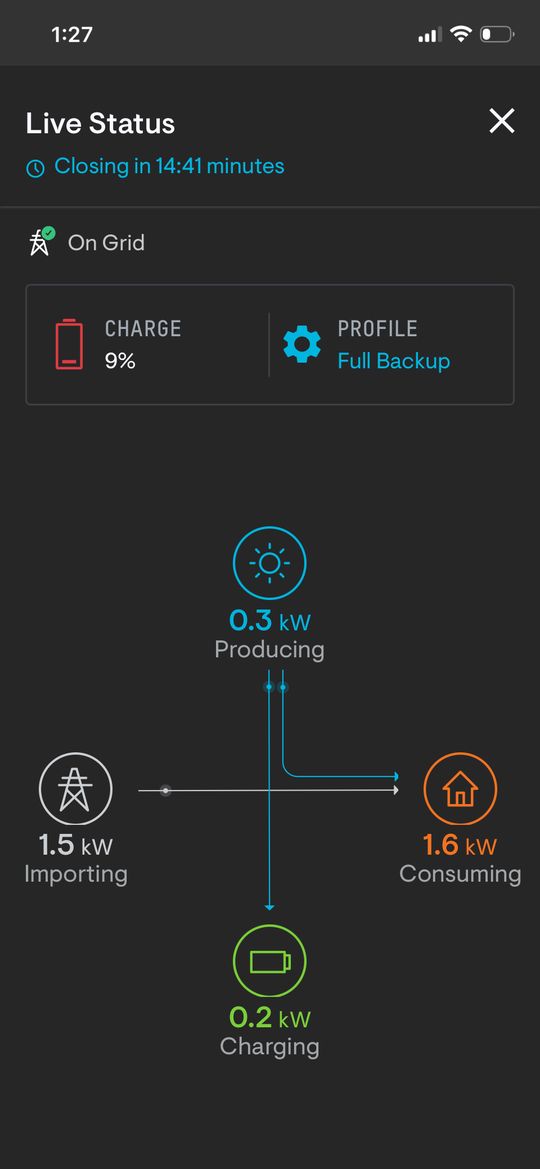 BACKUP NEARLY EMPTY
Profile Full Backup. Charge 9%. Grid importing 1.5 kW. Battery charging 0.2 kW — and that 0.2 kW is from solar.
Why it matters: the house is buying power from the grid while the battery sits nearly empty. That is energy we should already have stored.
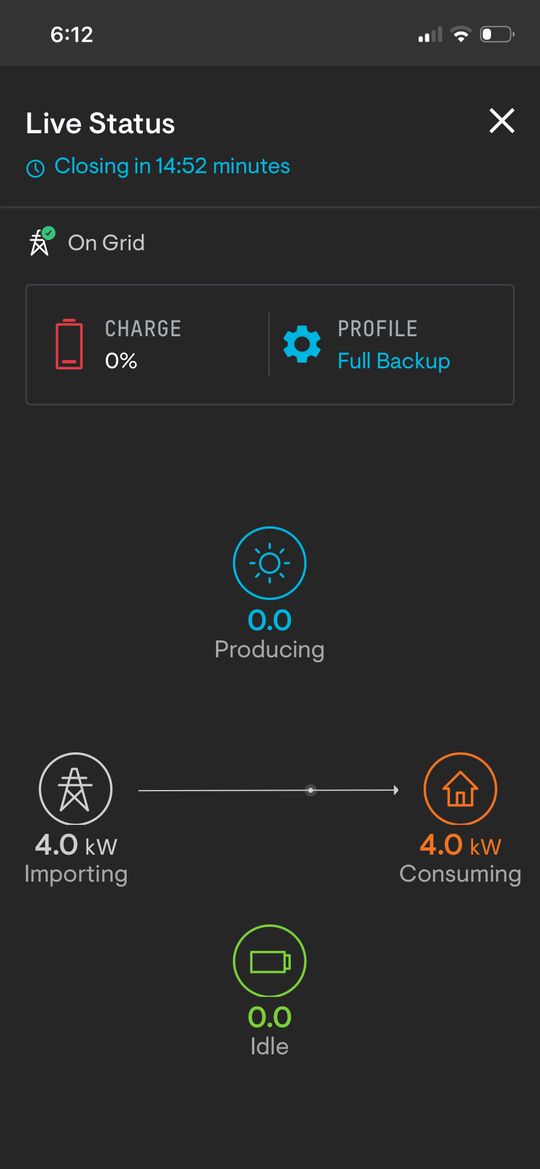 EMPTY, IDLE, IMPORTING
Profile “Full Backup”. Charge 0%. Solar 0.0. Grid importing 4.0 kW. Battery “0.0 — Idle”.
Why it matters: the battery is at 0% at 6 pm, the start of the expensive peak, and the house is drawing 4 kW from the grid. A battery bought to cover the peak has nothing to give.
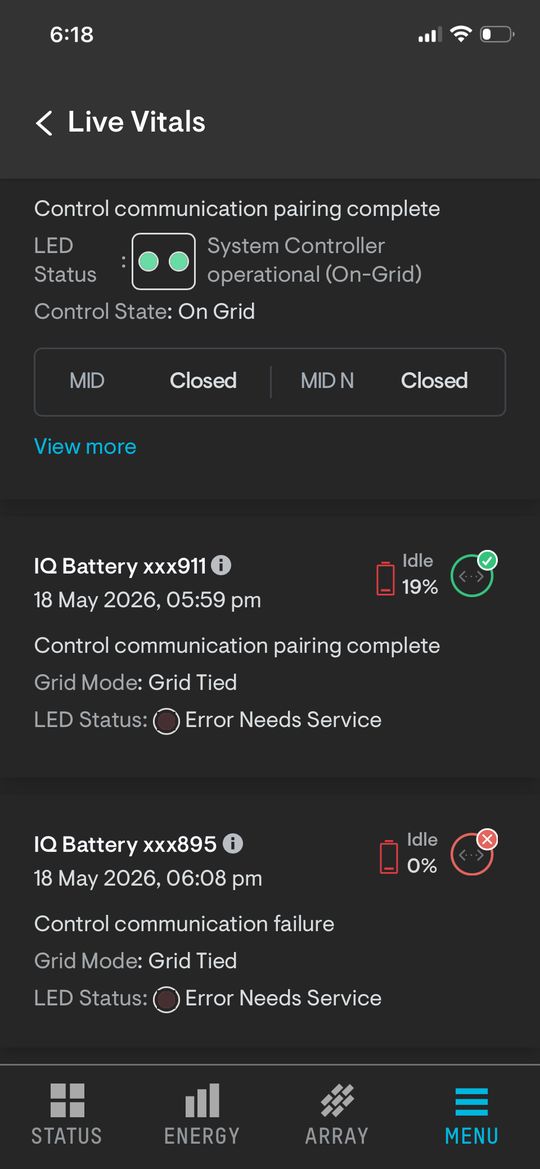 THE FAULT, NAMED
SN …911: “Control communication pairing complete”. SN …895: “Control communication FAILURE”, red ✗, 0% charge.
Why it matters: Enphase's own software names the fault, on a specific serial, on a fixed date. Control communication is how the battery is told to charge. If that link fails, no setting or firmware can fix it — it needs a technician.
20 May 2026 — the afternoon Enphase certified “no active fault”
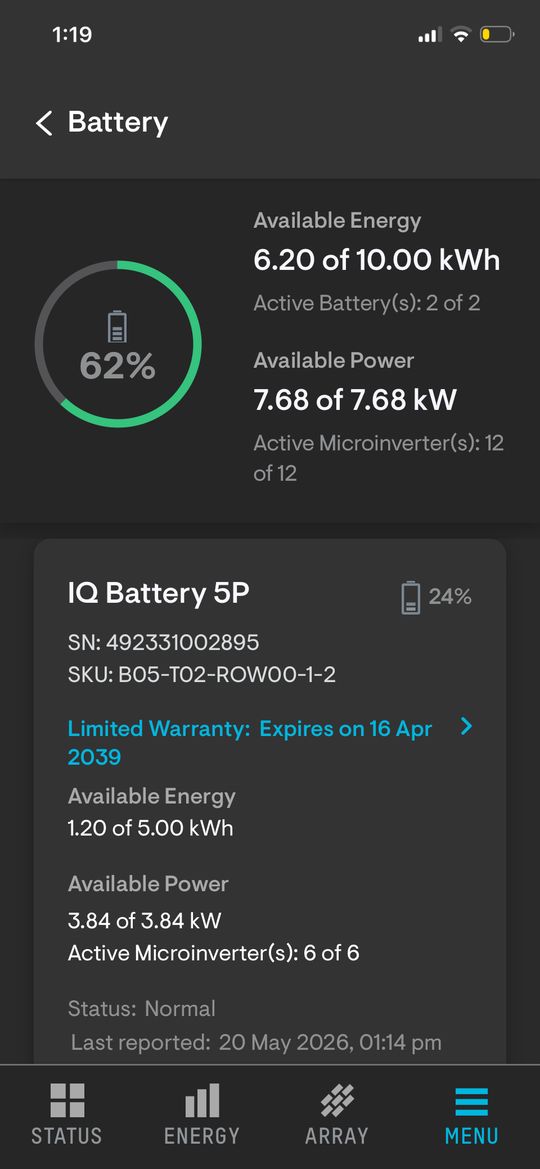 WRONG ON THE DAY
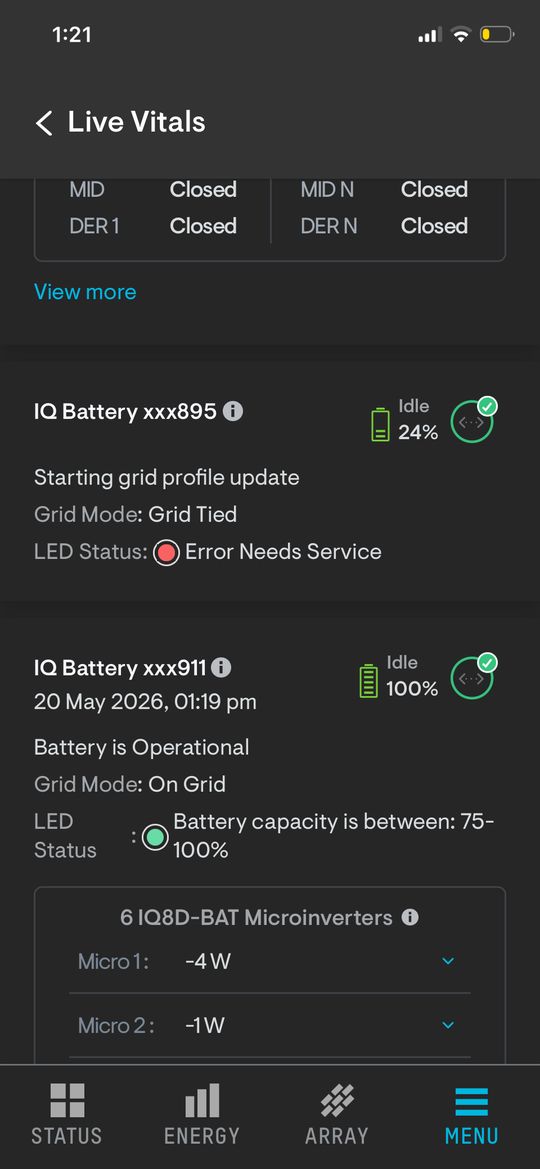 SERVICE ERROR
SN …895 — Idle, 24%, “Error Needs Service” in red. The app's own clock inside the image reads “20 May 2026, 01:19 pm”.
Why it matters: a live service error, on the afternoon Enphase found “no active fault”, two minutes after another screen said “Normal”.
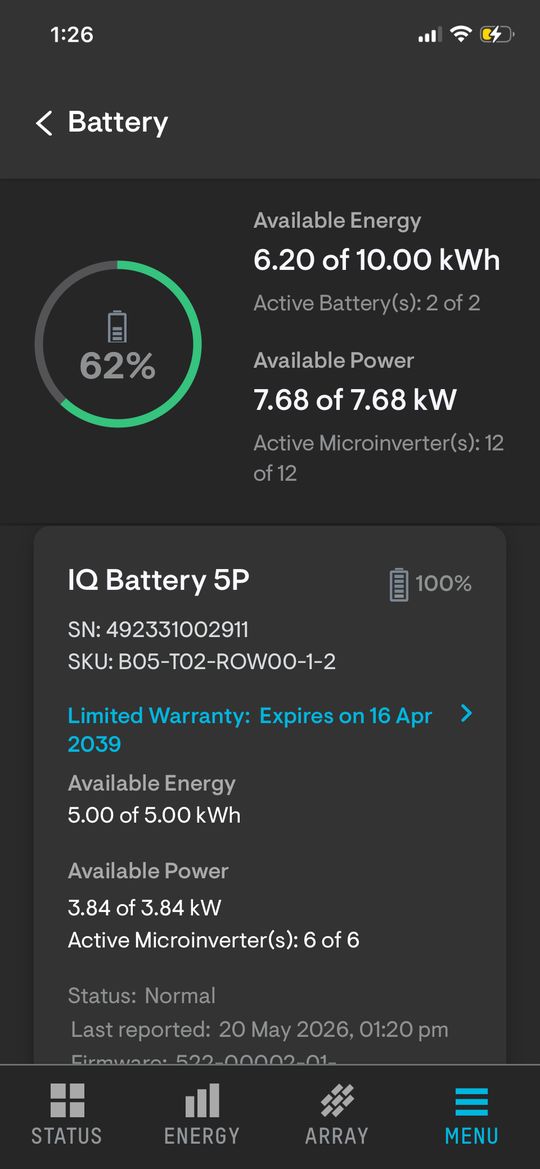 ONE FULL, ONE NOT
And the correlation nobody drew. The unit that failed to pair on 18 May (SN …895) is the unit sitting at 24% on 20 May. Its twin paired successfully and reached 100%. Both facts were in Enphase's own telemetry, two days apart, against two serial numbers.
18 September 2026 — the decisive pair
SETTINGS CORRECT
AND IT DID NOTHING
30 September 2026 — four months on, unchanged
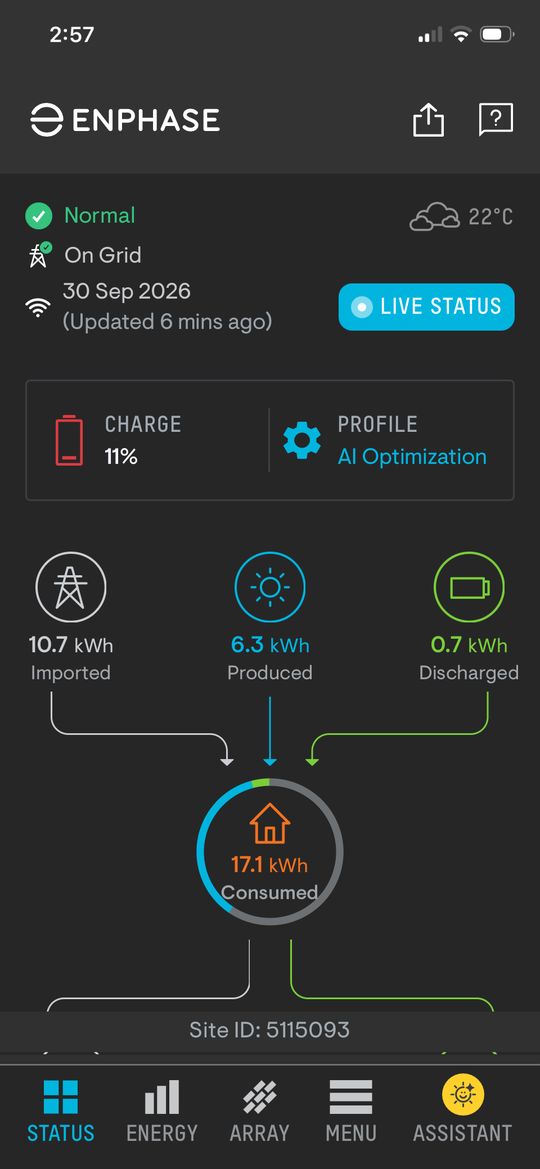 THE COST, IN ONE FRAME
9 — What it has cost
| 21 May – 23 Sep 2025 | 21 May – 21 Sep 2026 | |
|---|---|---|
| Grid import | 4,052.23 kWh | 7,756.02 kWh |
| Billed | $3,369.02 | $4,638.12 |
Same season, year on year, which controls for winter heating. The comparison understates the loss — the 2026 window contains four bills against five in 2025.
The control case: October 2024 — 663.70 kWh for $188.70. Almost identical grid import to my pre-fault average, at less than a third of the cost, because the battery was charging off-peak and covering the peak. That is what I paid for, and it is exactly the function that has failed.
10 — What I'm asking for
Primary: refund of $29,882.00 — or discharge of the $13,357.90 finance balance and repayment of instalments paid — plus $1,269.10 in excess electricity charges, removal of the equipment at their cost, and written confirmation that no default is recorded against my credit file.
Alternative, at my election: a qualified technician on site within 14 days with authority to replace hardware; faulty hardware replaced rather than reconfigured; escalation beyond first-level support by an engineer who has read the file; and 14 consecutive days of monitoring data showing grid charging actually occurring.
I would still much rather have a working system than a refund. I said so in writing on 11 June 2026, and I asked, repeatedly, for one thing: for someone to come and look at it.
11 — The schedule of claim
Under s 259(4) of the Australian Consumer Law a consumer may recover damages for loss reasonably foreseeable as a result of the failure, in addition to the primary remedy.
| Head of claim | Amount |
|---|---|
| Refund of the purchase price (or discharge of the $13,357.90 balance plus repayment of ~$12,496.10 paid) | $29,882.00 |
| Excess electricity, 21 May – 21 Sep 2026, from Nectr's own billing records | $1,269.10 |
| Excess electricity, 22 Sep to resolution — ongoing at roughly $250/month | continuing |
| Time: approx. 50 hours of troubleshooting, documenting and correspondence, at $75/hr | $3,750.00 |
| Finance interest on a non-functional asset · independent inspection · tribunal filing fee | to be assessed |
| Presently quantified | $34,901.10 |
What the 50 hours actually were: six-plus escalations and hours of phone troubleshooting; standing outside in the rain for half an hour at a time resetting equipment and reading out indicator lights; 90 minutes with the installer's technician on 2 October; capturing and organising roughly 100 screenshots with itemised times; and five months of correspondence re-explaining the same facts to three companies.
Every one of those hours was spent because nobody would attend, and because the evidence I was asked to produce was never read.
What I am deliberately not claiming. Australian law is restrictive about damages for distress in a goods contract, so I put no figure on it. I would rather this claim be taken seriously than padded. I record only that this has run five months and has materially interfered with my work.
A note on fairness. I have withdrawn one of my own claims on this page — the “12 of 20 microinverters” reading — because when I examined it properly it turned out to be wrong. I have left it visible rather than quietly deleting it. Every figure here comes from Enphase's own portal, Nectr's own billing system, or correspondence I am a party to. Where I quote someone, it is what they wrote or what I recorded at the time.