
I’ve spent most of my working life in and around IT: troubleshooting, reading logs, working out which part of a system is lying to the rest of it. So when my $29,882 solar battery stopped charging, I assumed I’d be the easy customer. I’d describe the symptoms precisely, the experts would recognise the fault, and someone would fix it.
Six months later, nobody has fixed it. And the question I keep coming back to is: if this is what someone with a troubleshooting background goes through, what chance does anyone else have?
- My battery is sold, set up and switched on to charge from the grid overnight on cheap power. Since about April 2026 it mostly doesn’t.
- I spent hours on the phone with Enphase support, including calls standing out in the rain reading the box’s lights to someone overseas. I was promised a firmware update that would “fix everything”. That happened three times. None of them did.
- In writing, I was told the batteries were “operational and charging with no errors”, that the system “may have shading”, and on one call that the battery “should not charge from the grid” at all.
- Enphase’s own documentation, Enphase’s own technician, and the settings screen of my own system all say the opposite.
- Nobody from Enphase has ever come to look at it. The installer’s one visit was spent on the phone to the same first-level support. The whole record is public: robhackney.com/enphase-nectr-OAS-solar-complaint.
I went in in good faith
The system is an Enphase setup, two IQ Battery 5P units and twenty microinverters, sold to me by my electricity retailer, Nectr, as a bundle, installed by Online Air & Solar, and financed on my power bill at $430.90 a month. For about six months it did exactly what it was sold to do. Overnight it filled up on off-peak power, and in the expensive 3pm–9pm window it ran the house.
Then it stopped. So I did what you’re supposed to do. I reported it in writing in May 2026, with screenshots. I rang Enphase. I rang again. I stood outside in the rain beside the battery cabinet with my phone to my ear, telling a support agent what each LED was doing, toggling settings in the app while they watched remotely, waiting while they “pushed something”, then checking whether anything had changed. Hours of it, cumulatively. Each time it ended the same way: there’s a firmware update coming, it’ll resolve everything.
For months I played it straight. I was the cooperative customer who speaks the language and does the tests. And the answers I got back seemed more designed to make the ticket go away than to fix anything. That’s the part that should worry everyone else.
The “fixes”
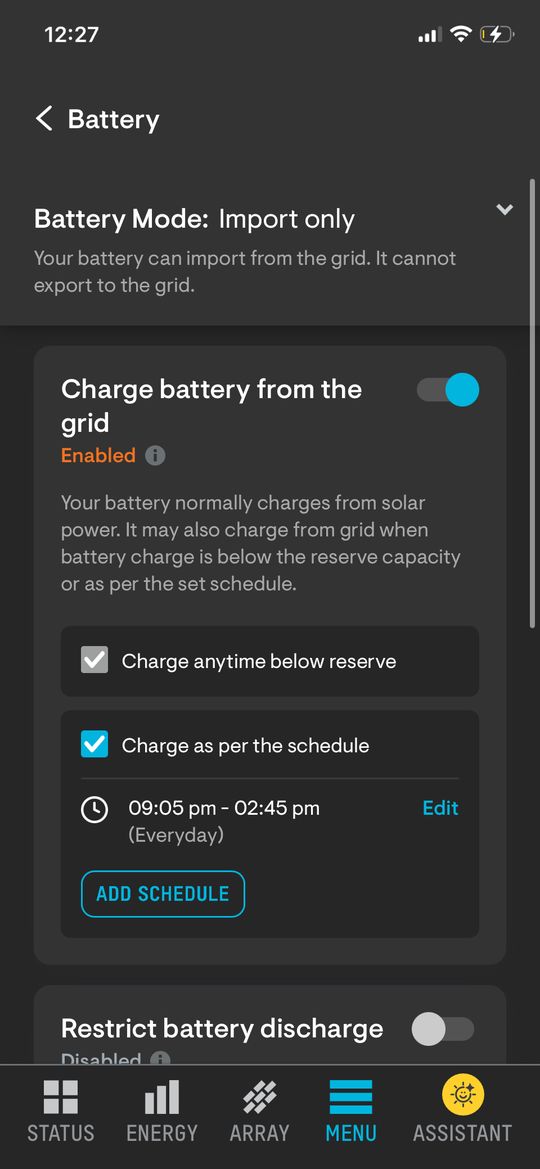
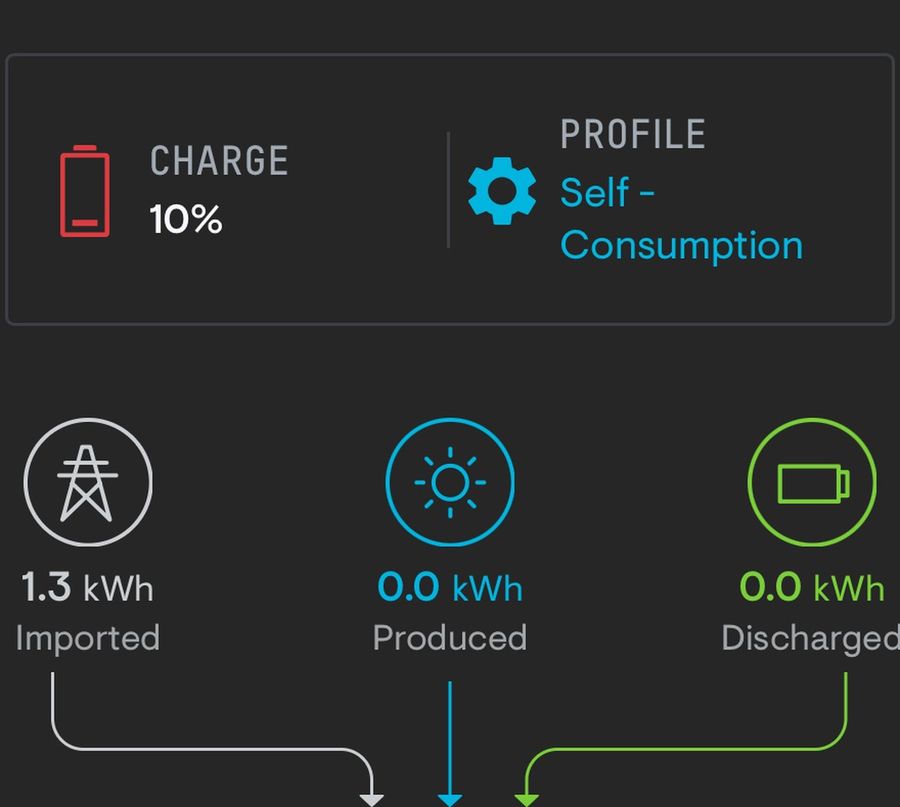
Here is what I was told, in writing and on calls, over six months. Read these with the screenshot below in mind: the battery sitting near-empty after midnight, grid power flowing, the charge window open, and nothing going in.
“Both batteries operational and charging with no errors.”Enphase Technical Support, written response relayed by my installer, 16 June 2026
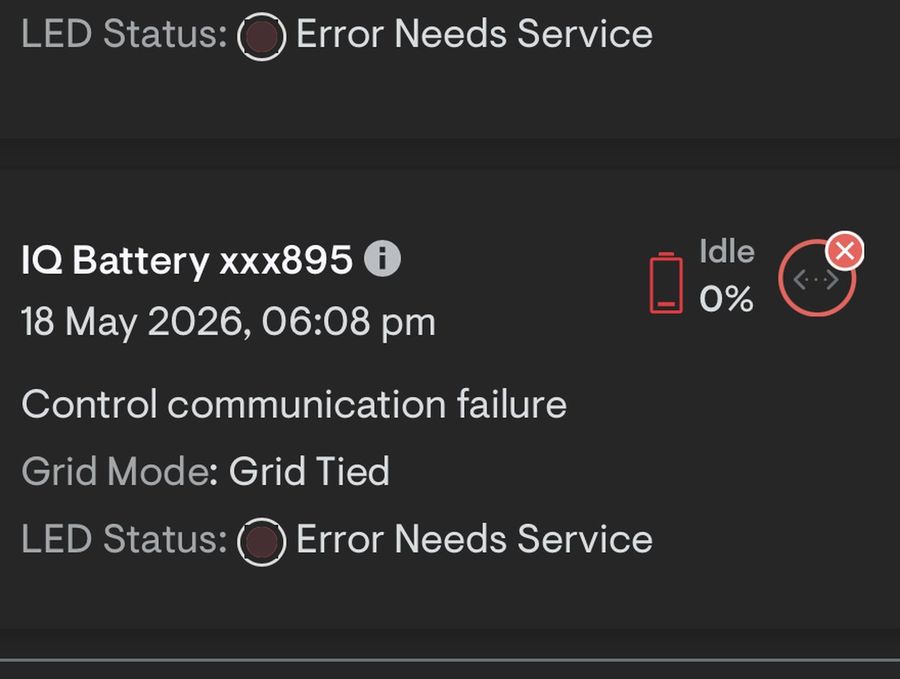
Four weeks before that was written, Enphase’s own app showed both batteries idle at 9% with the status “Error Needs Service”, and one of them showing “Control communication failure” with a red cross. It’s in the screenshots, with the file metadata to date them. → The screenshots, one by one
“System may have shading.”Enphase Technical Support, 16 June 2026
Shading. My panels haven’t moved, nothing has been built next to them, and no one has ever done a shade study or come to look. More to the point, the battery is meant to charge from the grid at night. There’s no afternoon shadow at 12:27am. Whatever is going on with the roof at 2pm, it has nothing to do with whether the battery takes cheap grid power after midnight. And that’s exactly the job it stopped doing.
“No active battery fault has been identified that would require a physical service attendance.”My installer, relaying Enphase’s remote diagnostics, 25 May 2026
That line was used to justify not sending anyone. The fault is intermittent: some nights the battery recovers, most nights it doesn’t. A remote spot-check at the right moment will always come back “healthy”. That’s exactly why intermittent faults need someone on site, and it’s exactly what never happened. → The contradiction, dated to the minute
“The battery should not charge from the grid.”Enphase representative, three-way call with my installer, October 2026
Sit with that one for a second. It’s a time-of-use battery on a time-of-use tariff. Charging from the grid off-peak is the whole economic point of it. And it isn’t my interpretation. Here’s what Enphase itself says.
What Enphase says the product does, beside what I was told
Two of those statements came from Enphase, about my system, within weeks of each other: one technician explaining in writing that it will pull from the grid during the charge window, and another representative telling me it shouldn’t. They can’t both be right. → Their marketing beside what I was told · Every claim, tested against the record
The installer visit: same queue, same script
Eventually my installer, Online Air & Solar, sent a technician. I’d waited in their queue for it, and by then I wanted one thing: someone with tools in front of the hardware. What I got was a technician who rang the same Enphase support line I’d been ringing, and spent the visit on the phone getting the same first-level treatment I’d had. Enphase told him there was a firmware fault with the battery and that an update over the weekend would fix it. That was firmware promise number three. On 6 October I reported that it hadn’t worked.
Before that visit the installer had told everyone involved that it had called Enphase twice, picked the callback option both times, and never got a call back. That’s the installer, the company I paid to look after this, describing itself as a middleman to a support desk that doesn’t ring back.
And when we finally got past the scripts, Enphase confirmed it hadn’t read the email history or the screenshots before giving its findings. The evidence existed and was sent repeatedly. Nobody looked at it.
The priesthood problem
Here’s what this taught me. A home battery is a black box with an app on the front. The app shows you a percentage, some coloured dots and a status line. Everything behind it, the telemetry, the error logs, the firmware, what “pushing an update” actually does, belongs to the manufacturer. Only they can see inside, so only they can say what’s wrong. And when they say “it’s working fine”, you have nothing to argue with but your power bill.
That’s a priesthood. You bring your offering (the symptom), they consult the oracle (remote diagnostics), and they come back with a pronouncement. It might be “shading”, or “settings”, or “it’s not designed to do that”, or “an update will fix it”. You can’t check any of it, because the instruments belong to them.
I could check some of it. I know what an intermittent fault looks like. I know a status line that says “Operational” sitting directly above one that says “Error Needs Service” means someone is reading the convenient field. I screenshotted everything, kept the file metadata, and set it against my own bills. My grid use went up 91% on the same months last year, about $1,269 extra. Nectr offered $150. → What it has cost
Now picture the same thing happening to someone’s elderly parent. Or a pensioner who bought the battery bundle because the retailer said it would cut their bills. Or anyone who doesn’t know what a firmware update is and has no reason to doubt the nice person on the phone. Told “it may be shading”, they’d probably accept it. Told “it shouldn’t charge from the grid”, they’d assume they’d misunderstood their own purchase. And they’d keep paying, on the bill, for a battery that doesn’t do its job, because leaving the retailer lets it call in the rest of the finance as a lump sum.
If someone who troubleshoots systems for a living can be bamboozled for six months, ordinary customers don’t stand a chance.
What should happen
None of this needed to be a fight. On 11 June I wrote that I’d much rather just have the thing fixed than take a legal route. That’s still true. What it needed in May was what it needs now: a qualified technician on site with authority to replace hardware, or a refund. Instead it has taken a formal letter of demand, which all three companies ignored, and complaints to Consumer Affairs Victoria, the ACCC, AFCA, the Essential Services Commission and the New Energy Tech Consumer Code. VCAT is next. → What I’m asking for
I’m publishing all of it because sunlight is the best disinfectant, and because the next person this happens to should be able to find it and recognise the pattern: the remote check that always comes back clean, the firmware update that will fix everything, the explanation that contradicts the brochure, and the site visit that never comes. If you’re living some version of this, document everything, keep the original screenshots, compare against your bills, and don’t let anyone tell you the product doesn’t do what it says on the box.
The full public record, with the timeline, every screenshot, the bills and the claims tested against the evidence, is at robhackney.com/enphase-nectr-OAS-solar-complaint. Journalists can download the media bundle from that page.
If you’ve had a similar experience with a bundled or financed home battery, I’d like to hear about it: r.m.hackney@gmail.com.